You’ve probably been told a dozen times: “just run Google Ads.” Like it’s the easiest thing in the world. And then you open the dashboard, see words like “bidding strategy,” “quality score,” “ad groups” — and quietly close the tab.
I get it. Honestly.
The truth is, most content out there on Google Ads is written for people who already know what they’re doing. Or it’s written to sell you an expensive course. Neither actually helps a small business owner in Jaipur or Coimbatore who just wants to get some leads without burning ₹20,000 for zero results.
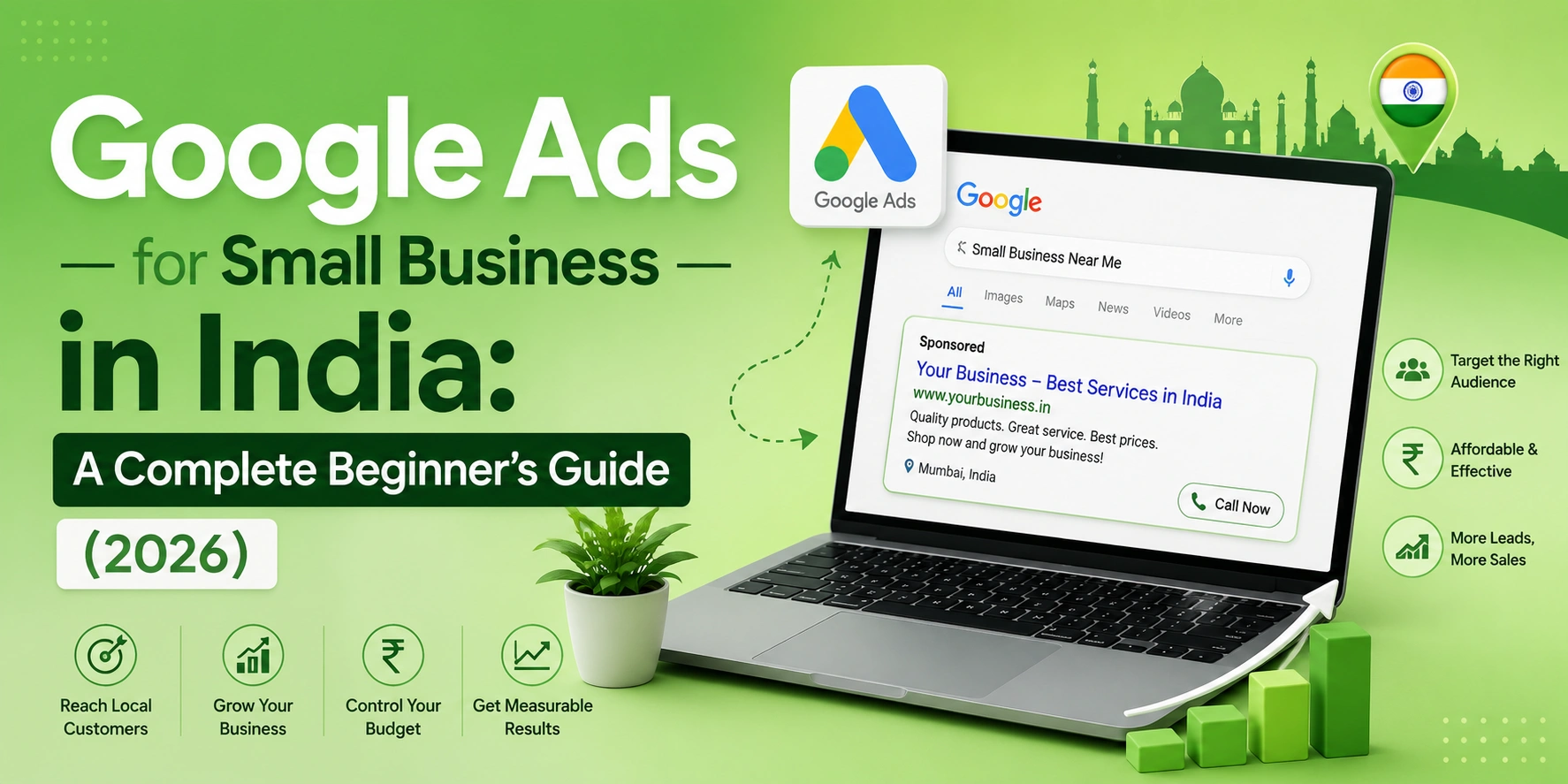
This guide on Google Ads for small business India beginners is different. No fluff. No agency-speak. Just a clear, honest breakdown of what Google Ads actually is, how to set it up without panicking, what it’ll cost you in India, and what to watch out for. Let’s get into it.
So What Even Is Google Ads? (And Why Should You Care)
Think of Google Ads as paying to show up at the top of Google when someone searches for what you sell. That’s it. Someone types “best pest control in Hyderabad” and your ad appears before the organic results. You pay only when they click. Not for showing up — only for the click.
That’s the part people miss. It’s not like a newspaper ad where you pay and hope. It’s much more targeted than that.
For Indian small businesses, this is genuinely powerful. India has crossed 900 million internet users. And a huge chunk of them are searching Google on their phones before making buying decisions. Even in Tier-2 cities. Even for local services like tailoring, coaching classes, or AC repair. This is why PPC advertising India small business has grown so fast — the audience is there, and the intent is high.
Here’s the thing. You don’t need a big budget. You need a smart one.
Google Ads Setup for Beginners: Don’t Let Google Trick You
This is where most people go wrong. And I mean really wrong.
When you first sign up at ads.google.com, Google will try very hard to push you into “Smart campaigns.” They’ll tell you it’s simpler and faster. It is simpler. But it’s also a black box where you have almost no control over where your money goes. I’ve seen people spend ₹15,000 in a month on Smart campaigns and get nothing useful from it.
So first thing: when you sign up, look for the option that says “Switch to Expert Mode.” Click it. Don’t skip this step.
After that, a Google Ads setup for beginners looks something like this:
• Choose ‘Search campaign’ as your campaign type — not Display, not Performance Max
• Set your location to the specific city or region you serve (don’t target all of India unless you genuinely sell nationwide)
• Set ad scheduling to your actual working hours
• Choose manual CPC bidding initially — automated bidding needs data to work, and you don’t have data yet
• Set your billing currency to Indian Rupees from the start
That’s honestly 80% of the setup. It’s not as complicated as it looks once you stop letting Google’s interface guide you toward what’s convenient for them.
One more thing on knowing how to run Google Ads in India specifically: language targeting matters here more than in most countries. India has a dual-language search behaviour — people often search in English but with Indian phrasing. “CA fees in Mumbai” not “chartered accountant services pricing.” Keep that in mind when you build your keyword list.
Read this: Google Ads vs Facebook Ads: Which Gives Better ROI
Google Ads Cost in India: Let’s Talk Real Numbers
Everyone wants to know this. And nobody wants to give a straight answer. So I will.
The cost-per-click (CPC) in India varies a lot by industry. Legal and finance keywords can cost ₹150–₹250 a click. Local services like plumbing or event photography might be ₹15–₹40. Here’s a rough breakdown of what Google Ads cost in India looks like across common small business categories:
Business Category
Avg. CPC Range (India, 2026)
Education & Coaching Institutes
₹15 – ₹60 per click
Legal / CA / Finance Services
₹80 – ₹200 per click
Local Services (repair, beauty)
₹15 – ₹55 per click
Healthcare & Clinics
₹40 – ₹130 per click
E-commerce (fashion, gifts)
₹10 – ₹45 per click
Real Estate
₹100 – ₹260 per click
Now, the question people really mean to ask is: “how much should I start with?”
Honestly, ₹5,000–₹8,000 per month is the realistic floor for a Search campaign that gives you enough data to work with. Below ₹3,000, you’ll get maybe 30–40 clicks a month. That’s not enough to learn anything or generate consistent leads. It’s just enough to feel like it doesn’t work.
A simple way to calculate your test budget: take your target CPC × 10 clicks a day × 30 days. If you’re in coaching and targeting ₹30 CPC, that’s ₹9,000/month. That gives you real data. That gives you something to optimise.
Keyword Research: The Part That Actually Determines If You Waste Money
You can do everything else right and still blow your budget if your keywords are off. This is the unglamorous truth of PPC advertising India small business campaigns.
Start with Google Keyword Planner. It’s free, it’s directly from Google, and it gives you India-specific volume and CPC data. Filter by your target city or state. The numbers will look very different from global averages.
A Google Ads tutorial India-specific tip that most beginners miss: Indian users search with commercial intent modifiers that differ from Western markets. Words like “charges,” “fees,” “cost,” “near me,” and “best in [city]” carry extremely high buying intent here. Build your keyword list around those.
And please — use Exact Match or Phrase Match. Not Broad Match. Broad Match is how you end up paying ₹80 for a click from someone searching “Google Ads jobs salary India.” That’s a real thing that happens. Every week.
Negative keywords are equally important. Add “free,” “jobs,” “salary,” “course review,” “DIY” from day one. Check your Search Terms report weekly and keep adding more. This is literally free money you’re saving yourself.
Writing Ads That People Actually Click
Here’s something most Google Ads tutorial India articles gloss over: your ad copy is what makes or breaks your CTR.
You get 3 headlines and 2 descriptions. That’s it. And yet most beginners write things like “Welcome to Our Company” as their headline. Nobody cares. Seriously.
Indian buyers respond to specificity. Numbers, prices, years of experience, trust signals. “Dentist in Pune — ₹499 Consultation — Book Today” will outperform “Best Dental Services in Pune” every time. Lead with what makes you different. And if you’re not sure what that is, look at your Google reviews and see what customers actually say about you.
Use all the extensions available to you — sitelinks, callouts, call extensions. Call extensions are particularly important in India where a lot of conversions still happen over the phone. If someone can call you directly from the ad without even visiting your site, your conversion rate goes up.
Tracking: If You’re Not Measuring, You’re Guessing
This section is short because the message is simple: set up conversion tracking before you spend a single rupee.
Most beginners skip it. They run ads, get clicks, and have no idea if those clicks became leads or sales. Then they say “Google Ads doesn’t work.”
Set up at least one conversion action — a form submission, a phone call, a WhatsApp click. Google’s tracking tag takes about 15 minutes to install. If you’re on WordPress or Shopify, there are plugins for this. It’s not optional. It’s literally the only way to know if what you’re doing is working.
Once you have data, check these five things weekly: CTR, CPC, conversion rate, cost per lead, and impression share. If your impression share is low, your budget is probably too small. If your CTR is below 2%, your ad copy needs work. If your conversion rate is below 1%, fix your landing page first — not the ads.
Google Ads vs Other Options: An Honest Comparison
Since you’re thinking about how to run Google Ads in India, it helps to understand where it fits versus other channels. Here’s a straight-talking comparison:
Channel
Honest Take
Google Search Ads
Best for high-intent buyers — they’re already looking. Costs more but converts better.
Meta (Facebook/Insta)
Great for awareness. Weaker for immediate lead gen unless your product is visual.
SEO (organic Google)
Free clicks long-term but takes 6–12 months to kick in. Do both.
YouTube Ads
Works well for building trust. Harder to measure direct conversions.
WhatsApp Business
Free, high open rates, but not scalable without a CRM behind it.
That’s why Google Ads for small business India beginners has become such an important topic in 2026 — small businesses want leads from people already searching to buy.
3 Mistakes Most Beginners Make (And How to Not Make Them)
1. Sending traffic to your homepage
Your homepage is not a landing page. It has too many options, too much distraction. Send ad traffic to a dedicated page that matches exactly what your ad promised. This single change can double your conversion rate.
2. Using Smart campaigns because they’re “easy”
Covered this earlier, but worth repeating. Smart campaigns give you almost no data and almost no control. For a proper Google Ads setup for beginners, Expert Mode is actually easier to understand because you can see what’s happening.
3. Not checking the Search Terms report
Every week, go to your Search Terms report and see what actual searches triggered your ads. You’ll be surprised. And sometimes horrified. Add the irrelevant ones as negatives immediately.
FAQs: Real Questions People Search
Is Google Ads worth it for small businesses in India?
Yes — Google Ads is worth it for small businesses in India when set up correctly with the right keywords and a focused budget of at least ₹5,000–8,000 per month. It works best for businesses where customers actively search before buying, like clinics, coaching institutes, and local services.
How much does Google Ads cost in India for beginners?
Google Ads cost in India for beginners typically starts at ₹5,000–8,000 per month for a basic Search campaign. Cost per click varies from ₹10 to ₹250 depending on your industry and competition level in your target city.
How do I start Google Ads for a small business in India?
Start by creating an account at ads.google.com, switching to Expert Mode, and setting up a Search campaign with city-level targeting, manual CPC bidding, and conversion tracking before spending anything. This is the foundation of any proper Google Ads setup for beginners.
Can I run Google Ads in India with a small budget?
Yes, you can run Google Ads in India with a small budget, but below ₹3,000 per month you won’t get enough data to optimise effectively. A ₹5,000–8,000 monthly budget targeting long-tail, city-specific keywords is a much more effective starting point for most Indian SMBs.
What is a good Google Ads tutorial for India beginners?
A good Google Ads tutorial India beginners should cover Expert Mode setup, keyword match types, negative keywords, India-specific search behaviour, and conversion tracking — not just the basics of clicking through Google’s guided setup wizard, which tends to favour Smart campaigns over manual control.
What’s the difference between Google Ads and SEO for Indian businesses?
Google Ads gives you immediate visibility but costs money per click. SEO builds organic rankings over 6–12 months but is free after the initial effort. For most Indian small businesses, running Google Ads while building SEO in parallel gives the best results — paid traffic now, organic traffic later.
Final Thoughts
Look, Google Ads for small business India beginners doesn’t have to be intimidating. The basics aren’t that hard once you stop letting Google’s onboarding nudge you toward options that benefit their revenue more than yours.
Start small. Set up Expert Mode. Pick your city. Use Exact Match keywords. Add negatives. Track conversions. Check what’s working after two weeks and adjust. That’s the whole system. It’s not glamorous, but it works.
The businesses I’ve seen get the most out of Google Ads aren’t the ones with the biggest budgets. They’re the ones who stayed consistent, kept a close eye on what the data was telling them, and weren’t afraid to pause something that wasn’t working.
Your competitor is probably running ads right now. The gap between you and them isn’t money — it’s just starting.